Not an actual patient.

Frequently asked questions about ELIGARD

Find answers to commonly asked questions below

Efficacy & Safety

ELIGARD has demonstrated durable testosterone suppression across 1-, 3-, 4-, and 6-month dosing options, and 92-96% of patients achieved T levels <20 ng/dL across all doses at week 24 of treatment.2 ELIGARD is supported by an extensive body of clinical evidence in advanced prostate cancer.2
Clinical studies have demonstrated rapid testosterone suppression following treatment initiation, with 94-99% of patients achieving T levels ≤50 ng/dL across all doses by day 28 of treatment.3 Patients also saw sustained suppression throughout the dosing interval.2
Common adverse reactions include hot flashes, malaise and fatigue, transient burning and stinging at the injection site, and testicular atrophy.3 Providers should review the full Prescribing Information for complete safety details.
Cardiovascular risk should be considered for all patients receiving ADT. Available evidence has not established a definitive cardiovascular safety advantage between ADT classes, and current guidelines recommend cardiovascular risk assessment and management throughout treatment.4 Increased risk of myocardial infarction, sudden cardiac death, and stroke has been reported in men receiving ADT. Monitor for cardiovascular disease and manage according to current clinical practice. ADT may prolong the QT/QTc interval; consider the risks and benefits in patients with a history of QT prolongation or receiving medications known to prolong the QT interval.3

Dosing & Treatment Scheduling

ELIGARD is available in 1-, 3-, 4-, and 6-month formulations, allowing providers to select the dosing option that best fits patient needs and treatment goals.3
The ELIGARD dosing calculator is available here and can help providers identify dosing schedules based on treatment planning needs.
Multiple dosing options allow providers to individualize treatment schedules and choose the option that best aligns with patient preferences, treatment goals, and practice workflows.3,5
ELIGARD offers long-acting dosing options of up to 6 months, while oral ADT options require daily administration.3,6 Providers may consider factors such as adherence, treatment preferences, and treatment schedules when selecting therapy.
Many long-acting ADT injections are available in only one or two dosing options and may require intramuscular administration.7-9 ELIGARD combines subcutaneous administration, 4 dosing options (1-, 3-, 4-, and 6-month formulations), and a unique in situ delivery system that provides sustained release throughout the dosing period, with one of the smallest injection volumes among long-acting injectable ADT therapies.3,5,10

Administration

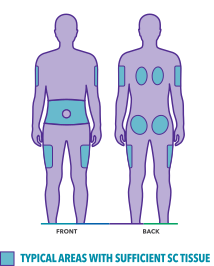
ELIGARD is administered as a subcutaneous injection by a healthcare professional using a short needle for delivery into subcutaneous tissue.3,5 ELIGARD can be injected into the abdomen, buttock, thigh, and upper arm, providing flexibility in administration and allowing healthcare professionals to select an appropriate site based on patient anatomy, comfort, and clinical considerations.3,5
ELIGARD may be administered in any areas with sufficient subcutaneous tissue including the abdomen, thighs, buttocks, and arms, providing flexibility in injection site selection.3,5
ELIGARD is a subcutaneous ADT with multiple injection site options, providing greater flexibility in administration and supporting individual patient and practice preferences.3,7-9 Subcutaneous administration offers a patient-friendly alternative to intramuscular injection, allowing treatment in areas with sufficient subcutaneous tissue and supporting a broad range of patient needs, including those with lower muscle mass, mobility limitations, or anticoagulant use. It also avoids injection into muscle and may help reduce the risk of bone- and nerve-related injection complications.5
Unlike oral ADT therapies that require daily administration, ELIGARD offers long-acting dosing options administered by a healthcare professional.3,6 Because treatment is delivered in the office and designed to provide sustained delivery throughout the dosing period, ELIGARD may help support treatment continuity while reducing reliance on daily adherence.3,10
Injectable ADT therapies vary in administration route, dosing frequency, injection site flexibility, and delivery systems.7-9 ELIGARD combines subcutaneous administration, multiple injection site options, 4 dosing options, and a unique pre-connected syringe system designed to support consistent preparation and administration.3 Following injection, ELIGARD’s in situ delivery system forms a solid drug depot that gradually biodegrades over time, providing sustained release of leuprolide acetate throughout the dosing period, offering flexibility to align treatment with individual patient needs.10
Yes. ELIGARD offers administration training resources, including instructional materials, training opportunities, and support tools for healthcare professionals. Find more training resources here.

Storage & Handling

ELIGARD should be stored according to Prescribing Information and can be left at room temperature for up to 8 weeks (56 days) prior to mixing.3 This provides flexibility for inventory management, treatment scheduling, and day-to-day practice operations.

Cost, Access, & Support

ELIGARD offers a variety of support resources, including TOLMARsync, aPC Central, Prostate Cancer 360, dosing tools such as the dosing calculator, administration resources, patient assistance information, and educational materials. Learn more about resources here.
TOLMARsync is an inventory and patient management platform designed specifically for healthcare providers to track, order, and dispense ELIGARD. It helps to manage treatment timelines, avoid supply shortages, and optimize patient care.
ELIGARD has comprehensive resources for patients and care partners, including IncreMENtal, Care Partner Corner, downloads such as the Getting Started With ELIGARD Guide and the Prostate Cancer 360 Roadmap, and patient advocacy groups. Learn more about these resources here.
ELIGARD provides access and affordability resources designed to help eligible patients navigate treatment costs and support programs.
ELIGARD has one of the lowest wholesale acquisition costs (WACs) among GnRH therapies and has not had a WAC increase in more than 10 years, helping support treatment access and affordability considerations.11
Healthcare providers can access ordering information through the ELIGARD ordering and procurement resources available here or by contacting a representative.
Providers can request to speak with an ELIGARD representative by signing up to request a representative here for product information, ordering support, training resources, and access assistance.

Sign up for ELIGARD updates or request a representativE

ADT, androgen deprivation therapy; GnRH, gonadotropin-releasing hormone; LHRH, luteinizing hormone-releasing hormone; T, testosterone.
References: 1. Data on file. IQVIA data, Jan 2025-June 2026. Tolmar, Inc.; 2026. 2. Shore ND, Chu F, Moul J, et al. Polymer-delivered subcutaneous leuprolide acetate formulations achieve and maintain castrate concentrations of testosterone in four open-label studies in patients with advanced prostate cancer. BJU Int. 2017;119(2):239-244. 3. ELIGARD (leuprolide acetate). Prescribing Information. Tolmar, Inc. 2026. 4. Data on file. CV Risk. Tolmar, Inc.; 2026. 5. Prettyman J, Engel L, Boldt-Houle DM, Atkinson S, Wilt W. Personalizing treatment in the delivery of care by nurses to patients with prostate cancer. Urologic Nursing. 2019;39(2):83-99. 6. Orgovyx (relugolix). Prescribing Information. Sumitomo Pharma Co., Ltd. 2025. 7. Camcevi (leuprolide). Prescribing Information. Accord BioPharma, Inc. 2026. 8. Zoladex (goserelin implant). Prescribing Information. TerSera Therapeutics LLC. 2026. 9. Firmagon (degarelix for injection). Prescribing Information. Ferring Pharmaceuticals. 2020. 10. Sartor O. Eligard®: a new form of treatment for prostate cancer. Eur Urol Open Sci. 2006;5(18):P905-P910. 11. Data on file. WAC. Tolmar, Inc.; 2026.
You are now leaving
ELIGARDhcp.COM

Are you sure you want to leave? 

Skip to content